
When MP Edward Chia enthusiastically demonstrated his ninja moves at the Senja Go Trail and Senja Warrior Course, we knew we had to check it out for ourselves.
Part of the newly opened Sport-in-Precinct (SIP) initiative, the facility is located within the cluster of blocks between 612 and 620 Senja Road. The aim is to bring a wider range of sports amenities closer to residents.
Making Our Way to the Sport-in-Precinct at Senja and the Senja Go Trail & Warrior Course
As newcomers to the estate, we initially had some trouble locating it. For those driving, the easiest access point is via the rooftop of BJ49 Multi-Storey Car Park.



Interestingly, the rooftop sits at the same level as the surrounding estate and provides direct access to both the Senja Go Trail and Senja Warrior Course.
Senja Warrior Course
The new facility is divided into two main zones.
The first, located nearest to the multi-storey car park, comprises the Senja Warrior Course and a fitness area.
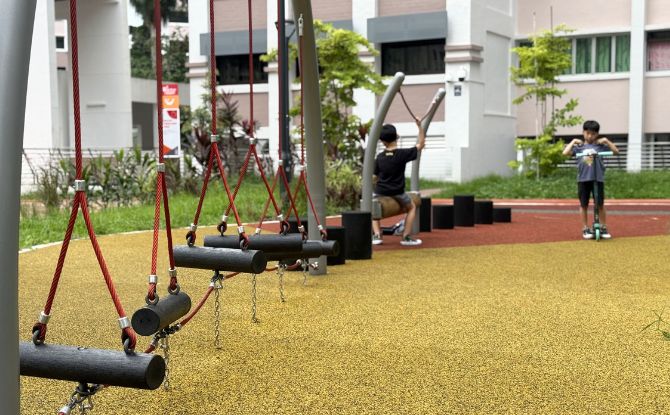
At the Senja Warrior Course, users can put their balance, agility and coordination to the test. Obstacles include balancing stumps, narrow beams, swinging logs and climbing nets.
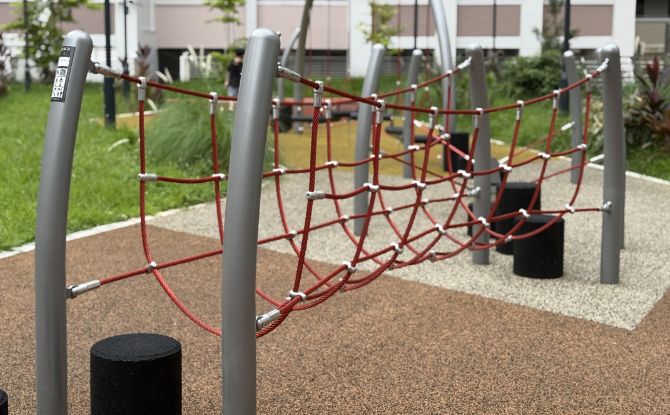
While energetic children will undoubtedly be drawn to the course, it also offers a fun challenge for adults and seniors looking to stay active.
Opposite the obstacle course is the fitness zone. Here, visitors will find a range of exercise stations similar to those commonly found in neighbourhood fitness corners. However, the equipment caters to a broad range of users and offers more than just light exercise.
Connecting the different zones is a looping track surfaced with synthetic rubber. The cushioned surface feels noticeably softer underfoot than conventional pathways.
Joggers can clock their laps comfortably, while children on scooters and skates will appreciate the smooth and forgiving terrain.
Lining the track are benches featuring health and fitness tips. For example, one station features a sit-to-stand test, which challenges users to repeatedly stand up and sit down within a minute.
Most adults aim for around 20 to 30 repetitions, making it a simple way to gauge lower body strength and overall fitness.
It is a subtle touch that encourages residents to pause, interact and pick up useful wellness insights along the way.
Senja Go Trail
The other zone is clearly designed with children in mind. It is divided into four sub-zones catering to different ages and play experiences.
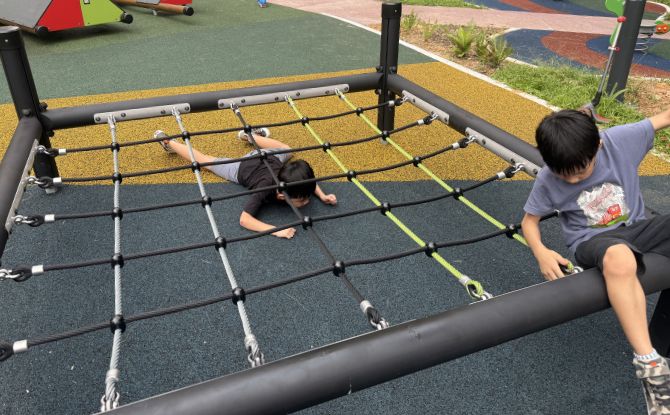
The first continues the ninja-inspired theme found at the obstacle course. A low netted structure encourages children to leopard crawl underneath. However, we noticed some adventurous ones making their way across the top instead.
The synthetic rubber flooring provides a cushioned surface, giving children the confidence to explore, crawl and occasionally tumble without worry.
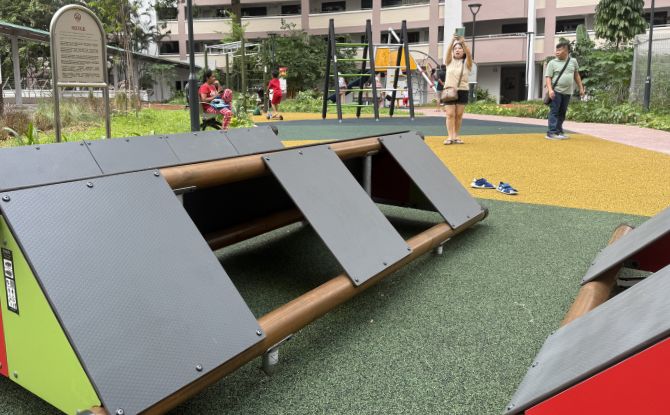
Next is a pair of sloping ramps that put balance, coordination and agility to the test.
The ramp on the left offers a gentler challenge with a fully enclosed crossing. The one on the right requires children to leap across a series of gaps to reach the other side.
While the obstacles may appear straightforward, they revealed quite a difference in abilities between the Boays. Adriel navigated them with ease, while Ashriel needed a little more time and confidence.
It was a timely reminder that agility and coordination are skills that need to be developed.
In an age where children spend more time indoors and on screens, having opportunities for active and purposeful movement is more important than ever.
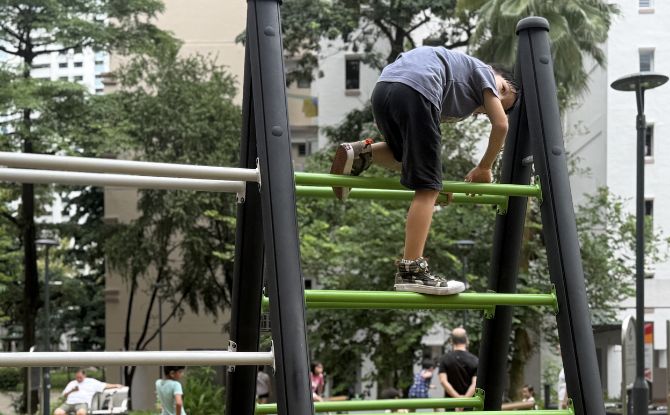
Completing the obstacle zone is a combination of A-frame climbing structures and monkey bars.
The A-frames encourage children to climb, balance and traverse across different levels, while the monkey bars provide a test of upper-body strength, grip and perseverance. Together, they round off the course with a satisfying physical challenge that rewards both determination and confidence.
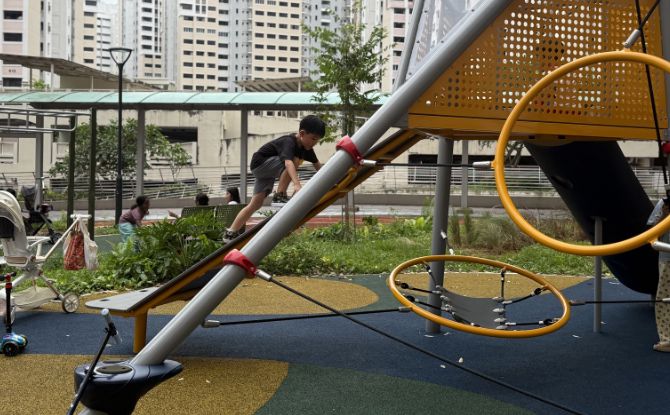
The second zone features a play structure. While it may not be as large or challenging as some of the playgrounds we have visited, it still provides children with opportunities to climb, balance and move confidently through the space.
We had hoped for a larger play structure. However, given the overall design intent of the Sport-in-Precinct — encouraging active living and developing physical literacy — it is easy to see why the focus is placed on movement-based play rather than a traditional themed playground.
The result is a space that complements the fitness and warrior course zones while giving younger visitors a fun way to build agility, coordination and confidence.
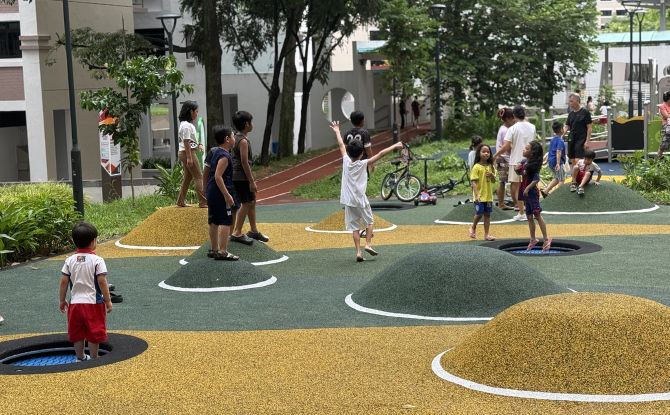
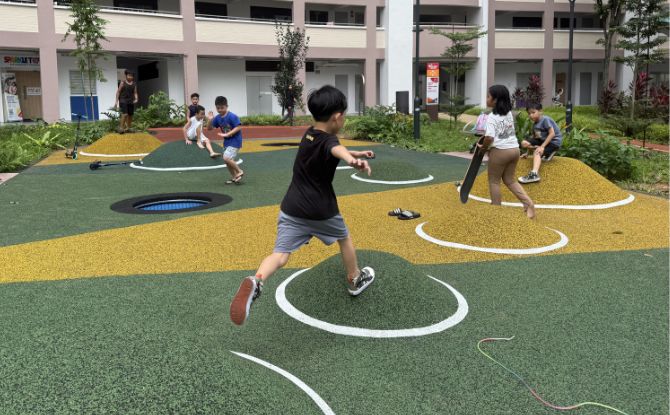
The third zone was perhaps the most innovative of the lot. Made up of a series of rubber mounds and in-ground trampolines, the setup is surprisingly simple.
There are no towering play structures or complicated equipment. Yet, it was one of the most engaging spaces we encountered.
During our visit, children quickly transformed the area into their own playground. Some used the mounds as stepping stones in a game of tag, while others challenged themselves to move across the space without touching the ground.
The trampolines became checkpoints, safe zones and launch pads, depending on the rules they invented along the way.
Open-ended Play
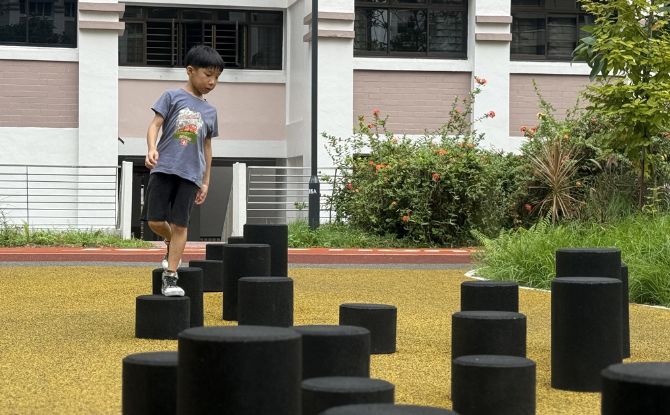
What impressed me most was how naturally the children created their own games and adapted the environment to suit their imagination. Watching them brought back memories of our own childhood, when games were often made up on the spot using whatever surroundings were available.
As I sat on the bench observing the activity, one thing stood out. None of the children seemed interested in screens or digital devices. Instead, they were busy negotiating rules, inviting others to join in and finding new ways to use the space.
It was heartening to see children from different backgrounds interacting so naturally with one another.
Sometimes, the most meaningful play does not come from elaborate equipment, but from a shared space that gives children the freedom to create their own fun.
Toddler Zone
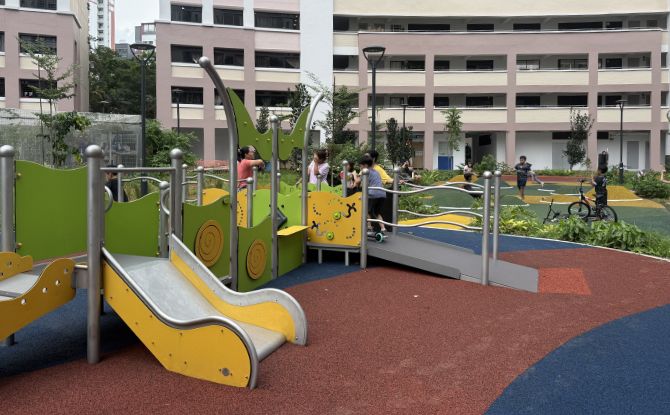
Of course, no play space is complete without a dedicated toddler zone. Located at the centre of the precinct, this low play structure is thoughtfully designed for younger children.
Climbing elements are largely absent, and for good reason. Rather than encouraging risky climbs beyond their abilities, the structure focuses on age-appropriate play that matches the developmental needs of toddlers.
Instead, little ones will find gentle ramps, low slides and interactive play panels. The slides are no higher than an adult’s waist, making it easy for parents to assist younger children when needed. These simple yet engaging features allow toddlers to explore, play and build confidence in a safe and comfortable environment.
Community Garden and More
Other features within the precinct include a community garden. Ashriel was particularly drawn to this space, eager to take a closer look at the plants. Its inclusion adds another layer of inclusivity to the development.
Beyond serving residents, the garden also provides opportunities for children and preschool groups to learn about gardening, nature and the environment through hands-on experiences.
Located further away is a sheltered basketball court. The covered design offers protection from the elements, making it a practical space for residents to gather, exercise and play regardless of the weather.
Fitness, Play and Community
Overall, the new Sport-in-Precinct at Senja is a thoughtful addition to the neighbourhood. By bringing together fitness facilities, play spaces and community amenities, it caters to residents of different ages and interests.
More importantly, it reflects how shared spaces can be designed to encourage active living, foster social interaction and strengthen community bonds within the estate.