

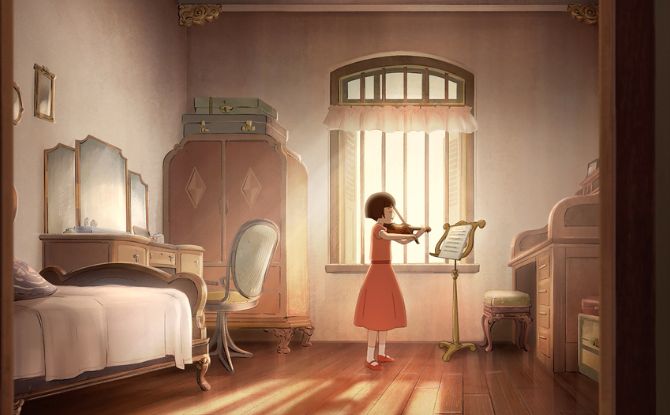
Some melodies fade over time, others return us to a time long past, yet continue to echo in our minds. The Violinist belongs to the latter.
The Violinist is an award-winning, Singapore-led animated film available in English and Mandarin that features Singaporean talents, including award-winning host and actor Guo Liang as war hero Lim Bo Seng, alongside Ayden Sng and Fang Rong as protagonists Kai and Fei. The film won the Cristal for a Feature Film at the Annecy International Animation Film Festival 2026 and received the SACEM Award for Best Original Soundtrack in a Feature Film.
The Violinist Plot
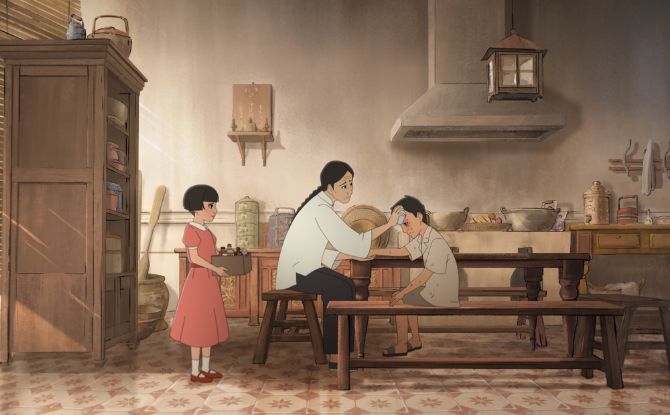



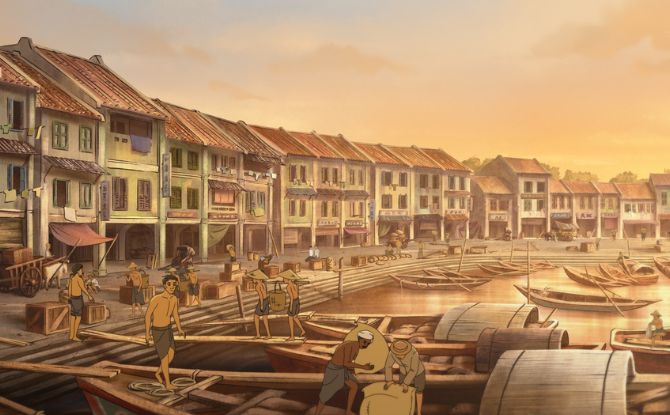
Set against the backdrop of Singapore and Malaya from the early 20th century through World War II to the present day, The Violinist tells a story of memory, friendship and resilience which resonate with moments that we could relate to.
The film follows two childhood friends bound by music as war and the passing years alter the course of their lives. Fei is a talented young girl from an affluent Peranakan family who, together with her gifted friend Kai, dreams of becoming a successful violinist.
Kai later joins the resistance when World War II breaks out and disappears. Fei commits herself to realising their shared dream of becoming a world-class performer and pledges to find him.
Beneath the sweeping historical canvas lie poignant moments. The ache of looking back and the hope that people and places of the past may still endure in memory.
The film invites audiences to draw strength from individual memories and collective history. It recalls not only survival and conflict, but also the personal relationships and achievements that time cannot entirely erase.
Storytelling Through Music
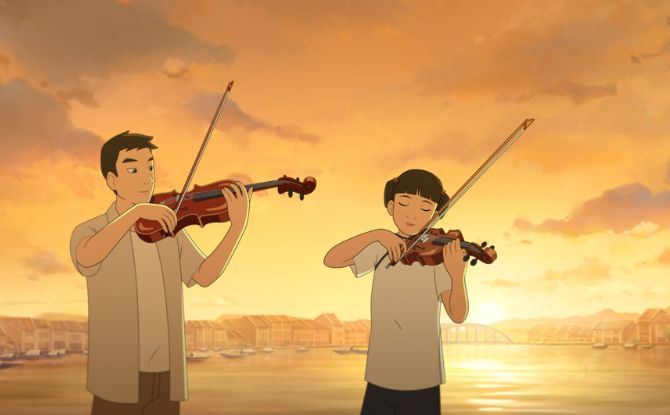
Music forms the film’s emotional thread, with an original score by Golden Horse Award-winning Singaporean composer Ricky Ho and Spanish composer Isabel Latorre, as well as virtuosic performances by Singaporean violinist Joy Yong.
The melodic movements bridge the characters’ growth from childhood to adulthood and connect the world that was with the world it has become.
Directed by Singaporean Ervin Han and Spanish animator Raul Garcia, the film is a testament to stories that transpire across borders and generations.
While some might initially find the film’s focus on music alienating, audiences will soon discover many relatable moments — heartwarming family huddles, playful bickering between friends and more.
Audiences in Singapore will also recognise familiar landscapes, such as the Singapore Botanic Gardens and the Esplanade.
As Ervin said, “Singapore was never simply a setting, it was the reason for making the film. Few places have transformed as dramatically within a single lifetime. By following one person across almost eight decades, we could tell a very personal story while watching Singapore change around her.”
The emotional connection brought viewers together, too. Audiences in the cinema breathed in collective tension when war broke out and people feared for their lives. Many also reached for tissues during moments of humanity shared by the most unlikely people who were supposedly enemies.
Hearing from Co-Director and Co-Writer of The Violinist Ervin Han
Curious to find out more about the film’s backstory, we reached out to the creative mind behind the film, Ervin.
What was the inspiration, or original spark, for The Violinist?
“It began with the idea of telling Singapore’s history not through great events or famous people, but through the life of an ordinary person and the music and memories she carries with her. I was interested in what history feels like when you actually have to live through it.”
How did this story begin? Did it begin with a character, an image, a piece of music or a particular theme that you were keen to explore?
“The original spark was my 2015 short film, ‘The Violin’, and really the violin itself: an object that could survive across generations and carry memories with it. From there came the characters and the idea of music connecting two people even when history pulls them apart.”
As director-writer for the film, what was the hardest creative decision you had to make on The Violinist? How has that impacted how the film turned out vis-à-vis your original vision when you first embarked on the project?
“Probably deciding what to leave out. When you cover so much history, the temptation is to include everything you’ve researched. Eventually we realised that history had to serve Fei and Kai, not the other way around. The finished film is tighter, more intimate and emotional because of that.”
From The Violin to Erhu and now The Violinist, music seems to take on a storytelling role, beyond an accompaniment in the animation films. What is it about music that makes it such a powerful way for you to tell stories? How have you used it in the narrative that also ties to Singapore’s history, memory and identity?
“Music can express things characters cannot put into words. I’m drawn to that, particularly in animation, where music and image can work together very freely. In The Violinist, music also becomes a form of memory – it connects people across different periods of Singapore’s history and carries something of the past into the present.”
When depicting a real place and time setting through animation, how do you balance between authenticity and artistic interpretation?
“We researched the history, architecture, clothing and everyday life extensively, but this is historical fiction, not a documentary. Animation inevitably involves interpretation: we simplify, heighten and sometimes compress reality in service of the story. The aim wasn’t to reproduce old Singapore photographically, but to make audiences feel they had stepped into a credible memory of it.”
Who Is This Film For? All of Us!
Portrayed against Singapore’s rich cultural tapestry, the film’s themes of separation, endurance and strength speak to audiences everywhere. It calls out to the universal longing for home, for people-to-people connection and hope for the future.
Every character holds their own and reveals the struggles brought about by difficult times and circumstances. Fei, who chases down the child who steals her food ration, only to later offer protection to the same child; Kai, who gives up his promising career as a violinist to join the resistance; and the families torn apart during the war.
It might have been a story of separation and loss, but it is also a reminder of the quiet courage that carries people through the darkest of times and of the memories that stay with us, just as an elderly Fei shows when she sits down with the journalist to share her story.
After-note by a Viewer (and Musician)
When I first saw the film title, I wondered if it was another biographical memoir about a musician (think The Pianist), or if it’s a music-themed film that had music prodigies competing against each other (I somehow thought of Nodame Cantabile). Turned out both might be applicable as a description of the film in some sense, but also not entirely accurate at the same time.
When Fei and Kai performed on the musical instruments early in the film, I confess that my mind automatically began checking whether the music instruments were shown accurately (the violin had four strings, checked).
As a musician, I had seen one too many inaccurate depictions of musical instruments, so I breathed a sigh of relief when I saw that the animators had done them fair justice. Even the position of the orchestra in the scene at the Esplanade Concert Hall was on point.
Creative licence was certainly used in the animation, but my attention quickly shifted from technical checks to full immersion in the storytelling. In fact, the film does not aim to target arts professionals. It is meant for people from all walks of life.
It tells of growing up years, friendships, struggles brought about by life’s circumstances and more. It is a film that seeks to connect with each one of us beyond the spoken language. As Ervin pointed out, music can express things that characters cannot put into words.
The Violinist was released in cinemas on 17 September 2026.