
For many who grew up watching The Legend of the Condor Heroes, Inner Mongolia conjures up images of endless grasslands and wide blue skies. Despite its appeal, it remains a destination that many families hesitate to visit. Concerns about hygiene, shared toilets on the grasslands and limited amenities often make travelling there with young children or elderly family members seem daunting.
Besides those concerns, school holidays meant we could only travel in June or December, both periods commonly associated with extreme weather. As we spent more time researching the destination on Xiaohongshu, we realised our assumptions were no longer accurate. Photos and videos posted by travelers showed comfortable hotels, up-to-date visitor facilities and well-developed attractions. We also learnt that early June offered pleasant weather, making it a good time to visit.
That gave us the confidence to finally make the trip. As we travelled with our two young children and both sets of grandparents, we found Inner Mongolia to be far more accessible and family-friendly than we had expected.
BILINGUAL PRESCHOOL & STUDENT CARE: Nurture Kids to Succeed in Heart & Mind
NEW & EXPECTANT PARENTS: Discover Gifts & Offers

In this article, we share our experience and the practical tips we picked up along the way, in the hope that they will make planning your own family trip a little easier.
TLDR 6DN Family-Friendly Itinerary to Inner Mongolia
Day 1: Flight into Hohhot
Day 2: Hohhot
Day 3: Xiangshawan
Day 4: Yuesha Island
Day 5: Huang Hua Gou / Hui Teng Xi Le Grasslands
Day 6: Wulanhada
6D6N Multi-generation Family Trip To Inner Mongolia
We flew with China Southern Airlines from Singapore to Hohhot via Guangzhou. Airfares were around S$500 per person. The journey comprised a four-hour flight to Guangzhou, a three-hour layover and another three-hour flight to Hohhot, the capital of Inner Mongolia.
Although the journey took almost an entire day, the stopover made it much more manageable, especially with two young children and elderly family members. The break gave everyone a chance to stretch their legs, walk around the airport and enjoy a Cantonese meal before boarding the second flight. If you’re travelling from Beijing instead, Hohhot is just 1½ hours away by high-speed rail.
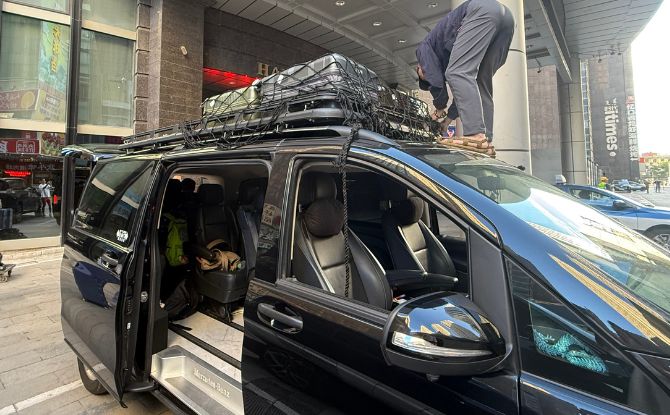
As we were travelling with eight people and covering long distances across Inner Mongolia, we hired a driver and travelled in a nine-seater Mercedes-Benz. The SGD2,000 fee covered our airport transfer from Hohhot, five days of travel around Inner Mongolia and the final drive to Tianjin. Having a dedicated vehicle made it much easier to move between attractions, especially with young children, grandparents and several pieces of luggage.
Our original plan was to book a 12-seater so that there would be more room for four large and two medium-sized suitcases. However, larger vehicles in China carry yellow commercial licence plates. Besides costing more, they are treated like coaches and are subject to additional restrictions. For example, they have to park at designated bus bays and are not allowed into certain attractions, including the Wulanhada Volcanic Geopark.
Hence, we opted for a roof-mounted luggage box. We were initially concerned about whether our luggage would be secure, but it proved to be sturdy, waterproof and dustproof throughout the trip. It was a practical and cost-effective alternative to hiring a larger vehicle.
Day 2: Hohhot
After spending almost an entire day travelling, it was a good place to ease into the trip before venturing further into Inner Mongolia.
Our first stop was the Inner Mongolia Museum. While it wasn’t as interactive as some of the museums we had visited elsewhere in China, it was contemporary, spacious and well maintained. The building itself surprised my mother-in-law, who had imagined Inner Mongolia to be far less developed. It was our first reminder that many of our preconceptions about the region were outdated.
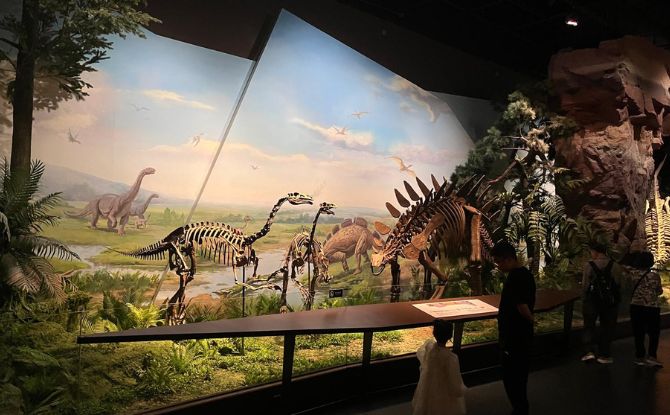
Admission is free for children and seniors. The highlight for our family was the prehistoric gallery, which houses an impressive collection of dinosaur fossils alongside interactive displays. Even as adults, we were amazed by the sheer number and variety of skeletons on display.
Another favourite was the space exploration gallery, where children can explore mock-ups of space stations and experience simulated rocket launches. The history and culture galleries, on the other hand, proved more popular with our parents, who happily spent time reading the exhibits.
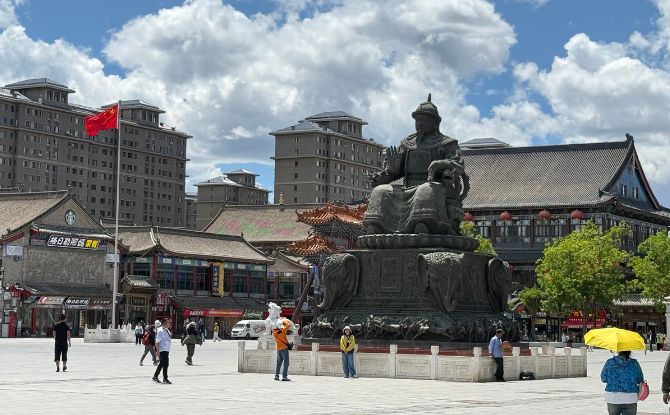
Around lunchtime, we headed to Sai Shang Lao Jie (塞上老街), a bazaar-style street popular with tourists. As we visited during the off-peak season, it was relatively quiet. Many of the souvenir shops carried similar merchandise and under the midday sun, we found ourselves moving through the street fairly quickly.
Just beside the street is Dazhao Temple (大召寺), the oldest Tibetan Buddhist monastery in Hohhot. Outside the temple, however, many visitors were dressed in traditional Mongolian costumes for photos, with the row of prayer bells providing a popular backdrop.
Lunch was one of our most memorable meals. The area is lined with restaurants serving frozen lamb hotpot, a local speciality. Using Dianping (大众点评), China’s restaurant review app, we found a highly rated restaurant nearby.
We learnt that the lamb is served frozen so that it cooks more gradually in the simmering broth, helping to retain its tenderness. We may have overestimated our appetites when we ordered the restaurant’s signature “lamb ring”, a huge circular platter of different cuts of lamb surrounding the hotpot.
If you’re more accustomed to pork or chicken, be prepared for a different dining experience. Many restaurants specialise almost exclusively in lamb and beef, from dumplings and buns to skewers and hotpot. What surprised us most was how mild the lamb tasted. Thanks to the breed, grazing conditions and local farming practices, it lacked the strong mutton flavour that many people associate with lamb. Even Adriel, who is usually a light eater, polished off several plates and asked if we could return another day.
After lunch, we spent the afternoon at MixC (万象城), one of Hohhot’s newer shopping malls. The swanky retail spaces, cafés, bakeries, supermarket and the popular Meland indoor playground offered a complete contrast to the morning’s sightseeing. With several busy days ahead, we decided to head back to the hotel early so that both the children and grandparents could rest.
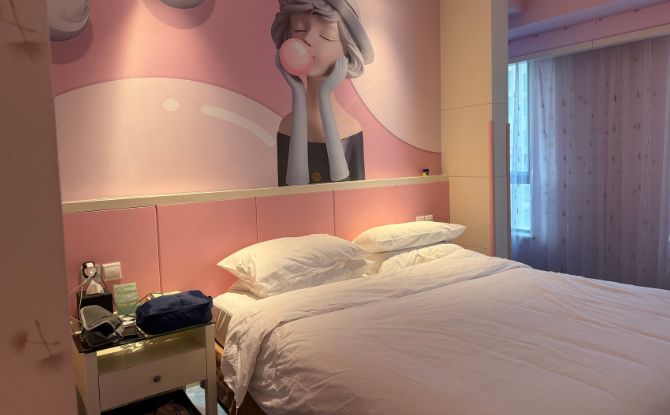
For our two-night stay in Hohhot, we chose Hailiang Plaza Hotel (海亮广场酒店). As our time in the city was limited, we wanted to stay in the city centre within walking distance of shopping malls and restaurants. Although there were several international hotel brands nearby, we opted for a local hotel instead.
The family suite cost around S$60 per night, while standard rooms started from about S$30. Our room included a cosy nook that could sleep one child, complete with children’s books, soft toys and child-friendly bathroom amenities. For the price and location, it proved to be excellent value.
Day 3: Hohhot > Xiangshawan (Sounding Sand Bay) 响沙湾, Ordos
Located near Ordos City, Xiangshawan is one of Inner Mongolia’s best-known desert destinations. The resort area combines accommodation, adventure activities, cultural performances and family-friendly attractions, making it easy to spend a day or two exploring the desert.
There are five resorts within Xiangshawan, ranging from camping-style accommodation to luxury stays. We chose Desert Lotus (莲沙度假酒店) for two reasons. First, it offers an all-inclusive experience, with meals, resort facilities and access to the two activity zones included in the stay.
Second, the resort itself is an attraction. Its award-winning architecture was designed to adapt to the shifting desert sands, allowing the buildings to settle naturally with the landscape over time.The decision wasn’t an easy one.
At around S$250 per person per night, a stay for our family of four cost almost S$1,000. Xiangshawan also sits about 2½ hours from Hohhot, while the rest of our itinerary continued towards Ulanqab. Staying there meant making a long detour before retracing part of our route the following day.
View this post on Instagram
In the end, we decided that spending a night in the desert was an experience we were unlikely to find elsewhere. To keep the trip within budget, we reduced our stay from two nights to one. One night gave us enough time to experience almost everything the resort offered over two days.
The moment we stepped into Desert Lotus, we understood why many travelers recommend staying here. The lobby’s floor-to-ceiling glass façade frames the surrounding dunes, while cosy seating areas invite guests to slow down and take in the desert views.
The lobby also houses a toddler play area, a gaming zone and a complimentary snack bar that’s open throughout the day. The Boays were thrilled when they spotted the PlayStation 5 consoles and briefly entertained the idea of gaming for hours. That excitement didn’t last long, though—we had a long list of desert activities waiting for us.
The guest rooms are arranged in a circular layout, resembling a lotus when viewed from above. The resort is so expansive that complimentary buggy services ferry guests between the lobby and their rooms.
Although our room was within walking distance, we hopped onto the buggy just for the experience. A full loop around the resort took about eight minutes, giving us a sense of its scale. Room categories range from standard rooms to larger suites with either desert or courtyard views. As we expected to spend most of our time outdoors, we opted for a standard courtyard-facing room.
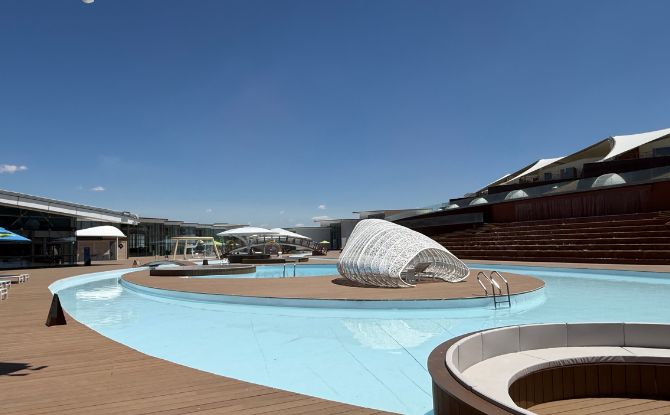
Beyond the desert attractions, the resort also offers a sports based activity centre, climbing facilities and a swimming pool. These are probably best enjoyed during a longer stay. Our package included breakfast, lunch and dinner, all served buffet-style. The variety was impressive, with everything from Chinese favourites to sushi and pizza, alongside free-flow drinks. Dinner was the standout. Guests could assemble their own Mongolian hotpot with unlimited lamb, beef and vegetables—a fitting meal after a day in the desert.
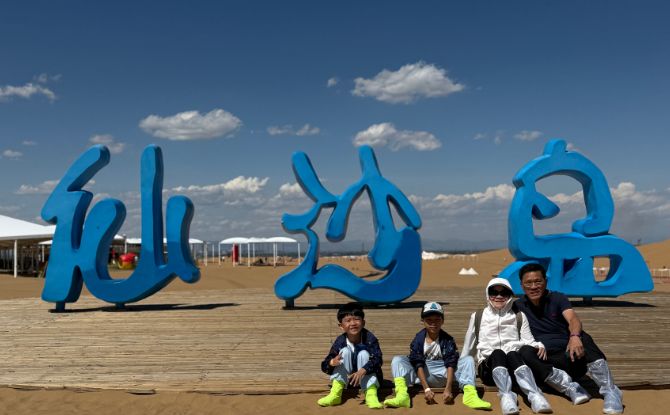
Resort guests enjoy complimentary transport to Xiangshawan’s central visitor area, where activities such as camel rides, desert buggies and helicopter tours are available at an additional cost. From there, visitors can take a scenic train to Yuesha Island (悦沙岛)or a desert yacht to Xiansha Island (仙沙岛).
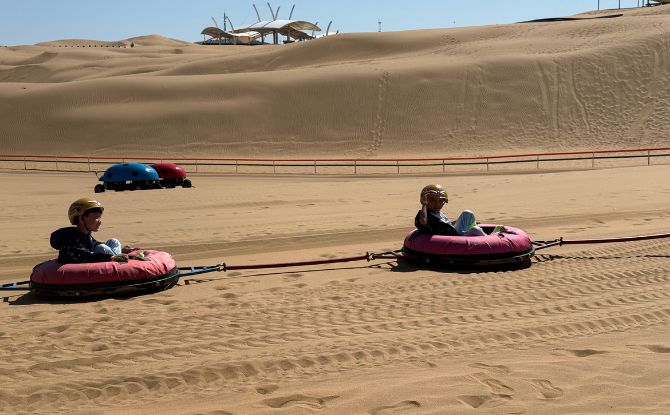
As the older grandparents preferred to rest at the hotel, we explored Xiansha Island with the younger grandparents. We soon realised that many of the more thrilling attractions, including the flying fox and roller coaster, have a minimum height requirement of 1.4 metres.
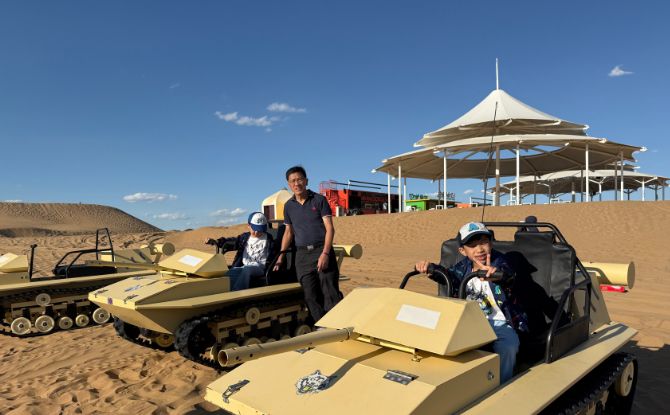
The rides available to the Boays, such as the mini train and sand sled, were more suited to younger children. Yet that hardly mattered. They really enjoyed driving the mini desert jeeps, playing on the bumper cars and sliding down the sand dunes. Watching Adriel happily digging and rolling around in the sand reminded me that children don’t always need the biggest or fastest rides. Sometimes, all they need is space to play with people they love.
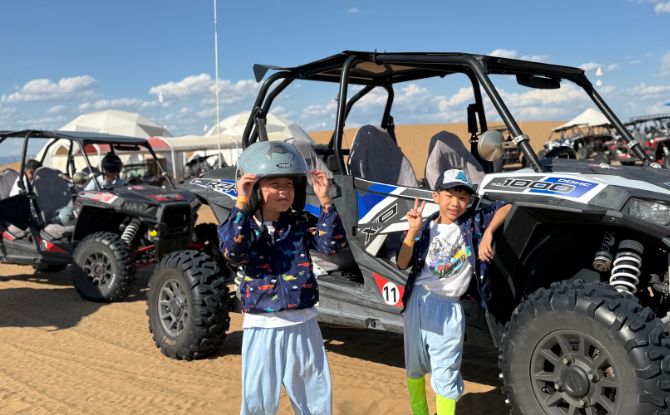
If you’re visiting Xiansha Island, do come prepared for the desert conditions. The island offers very little shade, so regular sunscreen reapplication is essential, even in early June. A pair of sand shoe covers is also worth buying before the trip, as we didn’t notice them being sold at the resort. Before heading back, look out for the yurt-shaped KFC and the oversized Coca-Cola vending machine—quirky additions that stand out beautifully against the sea of sand.
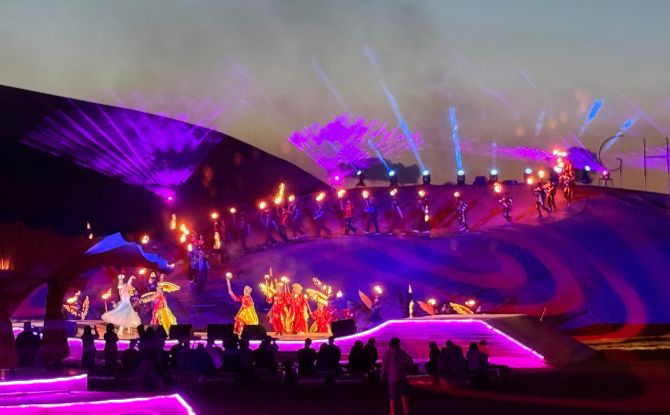
After dinner, don’t miss the nightly desert performance held within the resort grounds. The show combines acrobatics, fire effects and fireworks against the backdrop of the sand dunes. We settled into the beanbags laid out on the sand and watched the performance under the open sky. Surrounded by nothing but the vast desert, it was one of those rare moments when the pace of everyday life simply faded into the background. For the first time on the trip, it truly felt like we had left home behind and were on holiday.
Another unique experience was getting to launch fireworks ourselves (available at an additional cost). It wasn’t the handheld sparklers we were used to, but actual aerial fireworks that burst high above the desert—a first for both me and the Boays. Afterwards, the resort organised a small stargazing session, but after such a full day, we called it a night.
Day 4: Yuesha Island
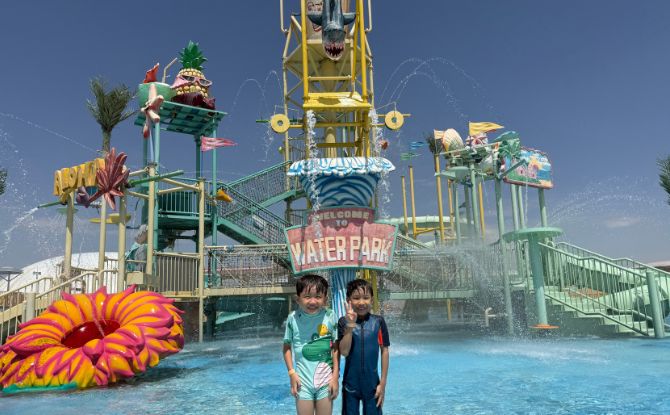
One benefit of staying at Desert Lotus is that guests can continue using the attractions even after checking out. The next morning, we headed to Yuesha Island, home to Xiangshawan’s water attractions.
Getting there was part of the experience. The scenic train rolls slowly across the dunes, offering uninterrupted views of the desert along the way.
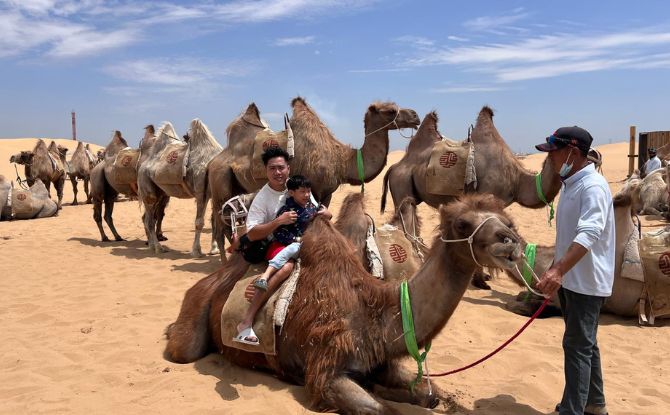
Like Xiansha Island, many of the larger water rides have a minimum height requirement of 1.4 metres. The Boays spent most of their time on the children’s water play area and enjoyed a camel ride. The water was surprisingly cold in the cool desert morning, but that didn’t stop them from having fun.
We also appreciated the ample shaded seating and beach chairs, which allowed the grandparents to relax while watching the children play. By early afternoon, it was time to leave Xiangshawan. Although we had hesitated over the cost and the detour it added to our itinerary, the stay became one of the highlights of our Inner Mongolia trip—and one experience we’re glad we didn’t skip.
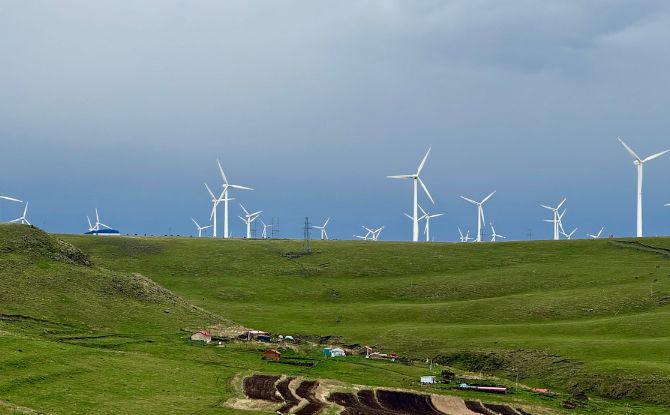
We spent the rest of the day travelling to Huitengxile Grasslands (辉腾锡勒草原) in Ulanqab (乌兰察布). Its name means “cold plateau” in Mongolian, and at an elevation of about 1,800 metres, the difference in temperature was immediately noticeable. The strong winds also explained the rows of wind turbines stretching across the grasslands. Everyone else seemed prepared for the weather except me—I was freezing. Fortunately, I managed to pick up a windbreaker shortly after we arrived.
Along the drive, we passed countless yurts scattered across the plains, with some owners enthusiastically waving at passing cars in the hope of attracting guests. What surprised us, however, was how many of these “traditional” yurts had been modernised with air-conditioning, proper beds and attached bathrooms. It made us wonder whether many travelers today are really paying for the novelty of sleeping in a yurt rather than a truly rustic experience.
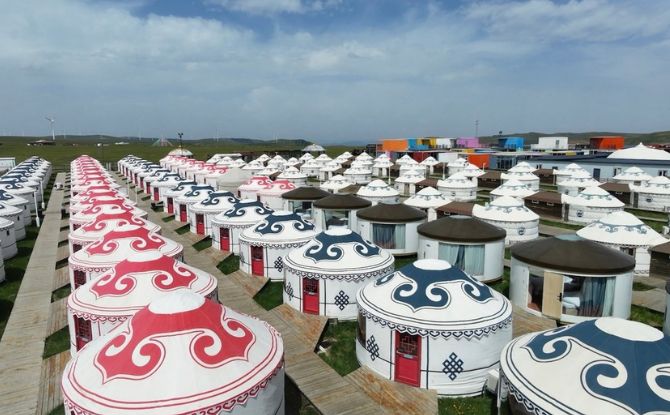
As we were travelling with the young and elderly, comfort took priority over novelty. We stayed at Star Pasture (星辰牧居), which offers both modern Mongolian-style yurts and hotel rooms. The hotel room costs about S$50 per night. After dinner, we called it an early night in preparation for the next day’s adventures.
View this post on Instagram
Day 5: Huang Hua Gou (黄花沟景区)“Yellow Flower Valley”
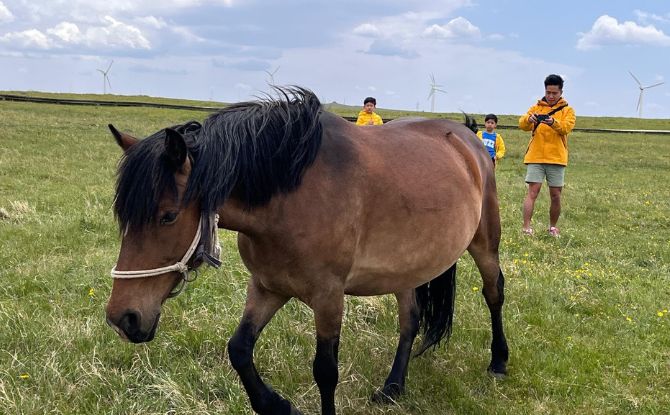
The next morning, we visited Huanghuagou Scenic Area, and it quickly became one of the quickly became our favourite stop in the grasslands.
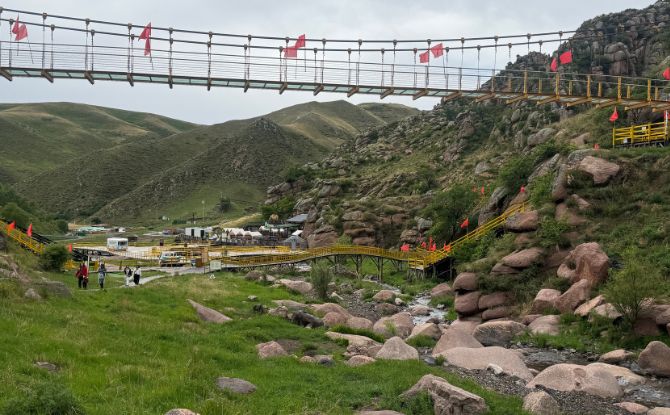
We had already been captivated by the rolling meadows and lakes around Huitengxile, but Huanghuagou brought all of these landscapes together in one place, with sweeping grasslands, rocky gorges and wooden boardwalks winding through the valley.
Our tickets cost around S$50 per person and included admission, internal transportation and the cultural performances within the park. The extensive network of boardwalks also made the area easy to explore with grandparents, allowing us to enjoy the scenery without tackling difficult terrain.
It is easy to spend half a day at Huanghuagou. We certainly did, stopping constantly for photos because almost every turn revealed another beautiful view. Visiting during the off-peak season also meant we had much of the park to ourselves.
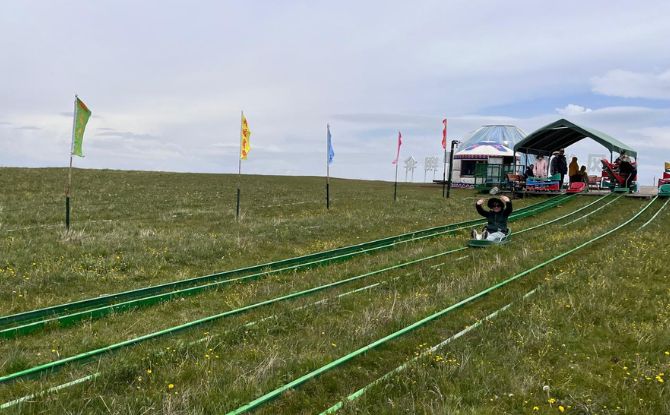
The downside was that several optional activities, including the flying fox, tubing slides and petting zoo, were closed. We managed to try only the grass slide. At RMB30 for a ride lasting less than a minute, it was worth experiencing once, although it looked more exciting in photos.
Hui Teng Xi Le Grasslands >Wulanhada
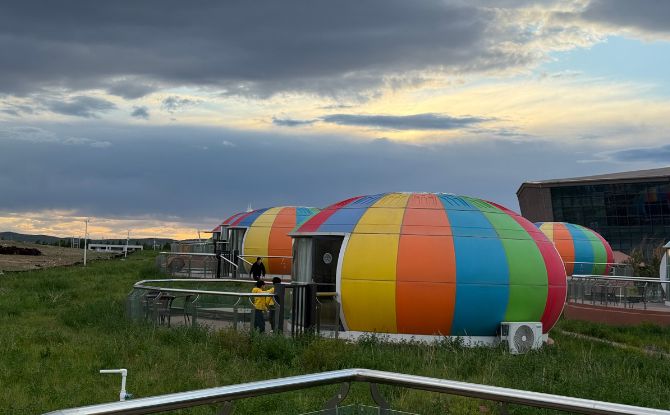
Leaving the grasslands behind, we made the one-hour drive to our final stop in Inner Mongolia—the Wulanhada Volcano Geopark (乌兰哈达火山地质公园). While the volcanoes were the main draw, Mars House (火山·火星营地) ) exceeded our expectations.
Mars House, a collection of cabins inspired by traditional Mongolian yurts but given a contemporary, space-themed twist. Each cabin is named after a planet and comes with a cosy sleeping area, separate shower and toilet, as well as a private courtyard overlooking the volcanic landscape.
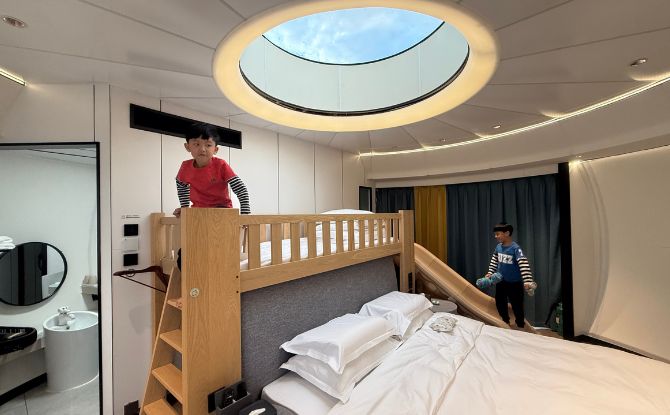
The resort offers several room categories, from double rooms to family suites and two-bedroom cabins for larger groups. We chose the family suite, and it was an instant hit with the Boays thanks to the bunk bed complete with a slide. For the adults, the highlight was the sliding skylight above the bed, which could be opened for stargazing on clear nights.
At around S$250 per night, the stay also included breakfast, a complimentary tube of fireworks, access to the mud pools, indoor water playground and public hot spring baths.
Looking back, setting aside at least half a day to enjoy the resort would have made the experience even more worthwhile.
View this post on Instagram
Day 6: Wulanhada Volcano Geopark
The next morning, we headed to Wulanhada Volcano Geopark, home to more than 30 dormant volcanoes. Unlike the steep volcanic peaks that many of us are familiar with, these volcanoes have gentle slopes, making it possible to hike up to several of their crater rims.
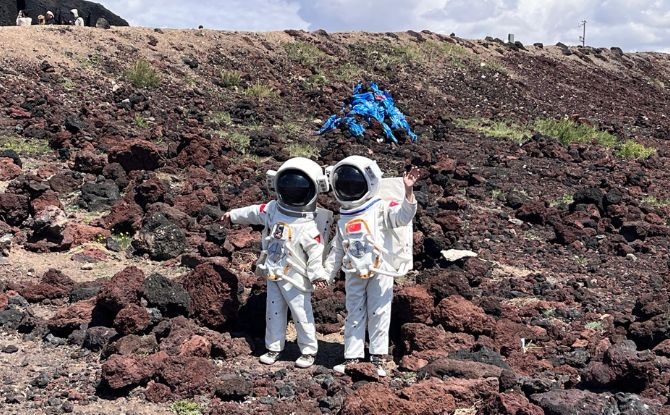
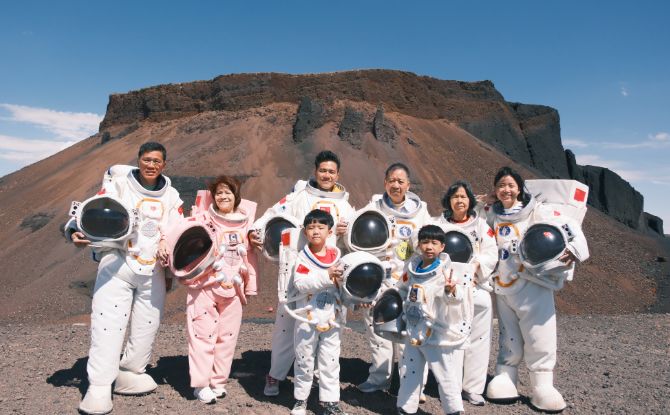
Having seen countless photos on Xiaohongshu, I had been looking forward to renting the astronaut suits. To my surprise, even the grandparents were game enough to join in.
Watching three generations of our family posing in matching space suits against the Mars-like landscape was every bit as memorable as the scenery itself.
Astronaut suits can be rented at Volcano No. 6, where professional photographers are also available for around RMB200–300 if you’d like help capturing the perfect shot. Another popular photo prop is the coloured smoke flare, which costs just RMB8 and creates a striking contrast against the dark volcanic landscape.
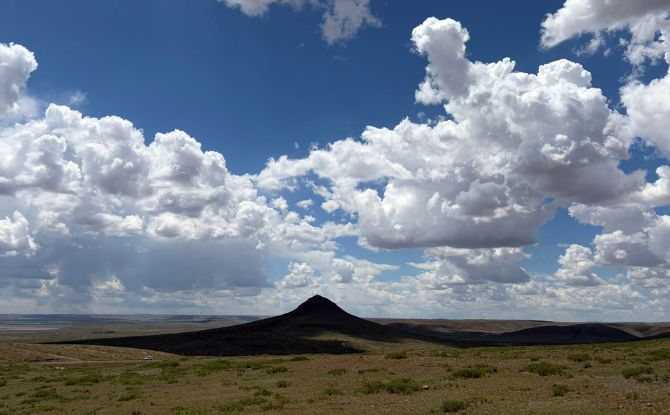
We spent about three hours at the geopark, most of it taking photos, although you could easily spend half a day here if you plan to visit several volcanoes and try the different activities. Each volcano has its own distinctive features. Volcano No. 3 is the only one with a boardwalk leading to the summit, making it one of the easiest to explore. Volcano No. 5, which was featured in China National Geographic, is regarded as the best-preserved volcanic cone in the area.
Meanwhile, Volcano No. 6 is the park’s most photographed landmark, thanks to its barren terrain that closely resembles the surface of Mars.
The Boays enjoyed exploring Volcanoes No. 7 most. Besides searching for agates among the volcanic rocks, we also rented a self-drive 4WD buggy for about S$50, which allowed us to drive around the foot of the volcanoes. This added another layer of fun to the visit.
View this post on Instagram
Wulanhada > Tianjing
After spending half a day at the geopark, it was time to bid Inner Mongolia farewell. Although the region is vast and there were still many places we did not have the chance to explore, the past six days had already taken us through an incredible diversity of landscapes.
From deserts and alpine grasslands to volcanic terrain, it was a combination we had never encountered on a single trip before.
From Wulanhada, we embarked on an eight-hour drive to Tianjin, where we would begin the next leg of our journey. Having visited Beijing earlier in the year, we decided to explore a different city instead.
Our Tianjin adventure deserves a story of its own, which we’ll share in a separate article. If you’re planning your own itinerary, however, pairing Inner Mongolia with Beijing is also a popular option.
On a Final Note
Looking back, Inner Mongolia surprised us by being very different from what we had imagined. The well-equipped infrastructure, family-friendly attractions and comfortable accommodation made travelling with both young children and grandparents far more manageable than we had imagined.
More importantly, the trip completely changed how we viewed the region. What began as a journey beyond the Great Wall became six days of discovering deserts, grasslands and volcanoes together as a family. It remains one of the most unique trips we have taken—not because it was remote, but because it showed us just how accessible and rewarding Inner Mongolia can be for travellers of all ages.