

Located within the newly developed Punggol Digital District, the Punggol Heritage Trail is part of the old Punggol Road that used to lead to Punggol Jetty. It is designed to complement the surrounding green spaces including Punggol Waterway Park, Punggol Waterway and Punggol Point Park and it is also home to the Punggol Heritage Trail Adventure Playground.
Punggol Heritage Trail

At the moment, the first 400-metre stretch of Punggol Heritage Trail, from Punggol North Avenue to Campus Boulevard has been opened. This is part of the entire 1.3-kilometre pedestrianised Punggol Heritage Trail that will open at a later time.
When completed, the Punggol Heritage Trail will connect Punggol Waterway Park to Punggol Point Park, providing convenient pedestrian access from residential estates, the SIT campus and offices in Punggol Digital District to a variety of green spaces – including Punggol Waterway Park, Punggol Promenade Punggol Point Walk, and onwards to Coney Island Park – as well as community amenities such as Punggol Coast MRT station and the hawker centre.
DISNEY ADVENTURE CRUISE: Guide and Tips to Disney's Latest Ship
MARCH HOLIDAY FUN: 20+ Things to with Kids in Singapore



Punggol Heritage Trail Adventure Playground
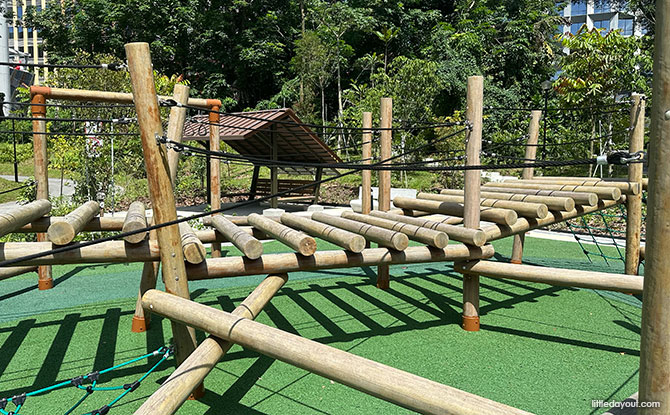
The Punggol Heritage Trail Adventure Playground is located close to SIT and the Punggol Coast Mall. This makes it convenient to reach for families shopping at Punggol Coast Mall.
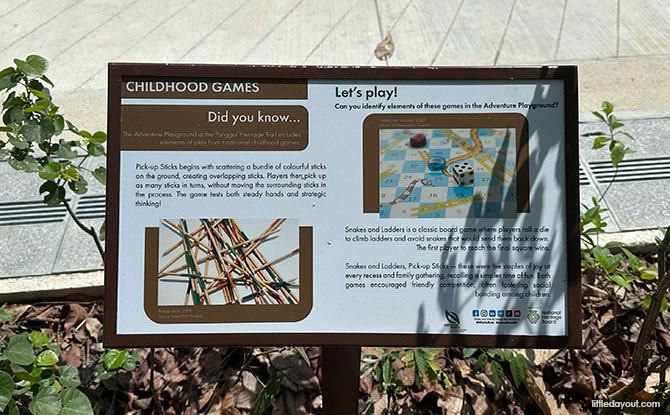
According to a signboard, the Adventure Playground borrows some elements from the childhood games of pick-up sticks and snakes and ladders.
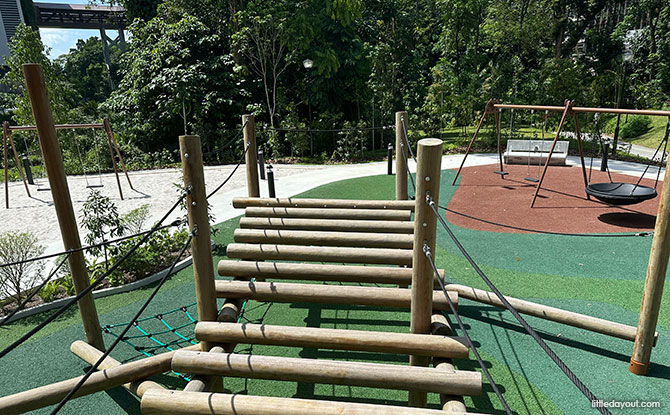
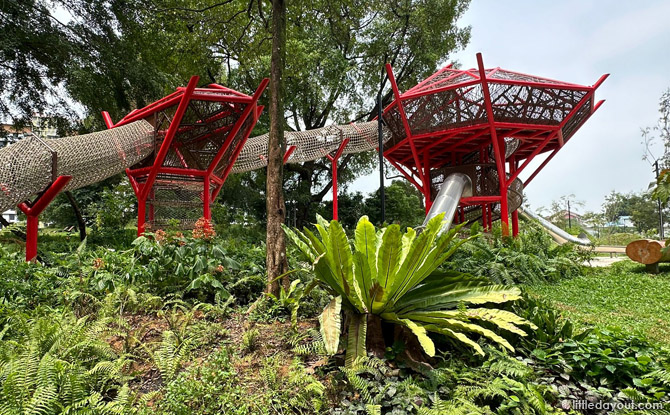
Made out of wood, the main play structure at the playground consists of an elevated log bridge.
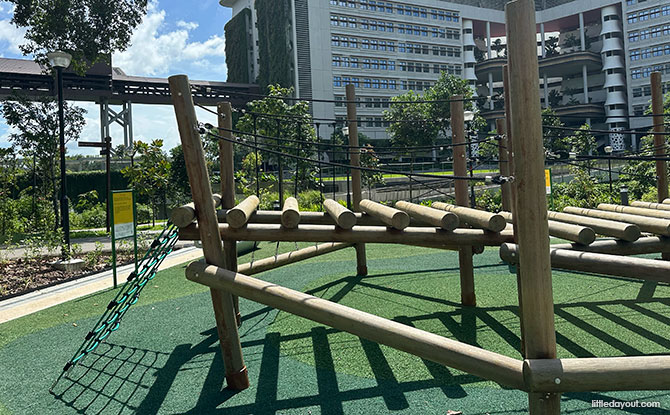
Kids can use the cargo nets on either end to reach the raised logs and carefully step their way across the logs.
Want to practise balancing? There are lower logs that can be used by kids to test how surefooted they are.
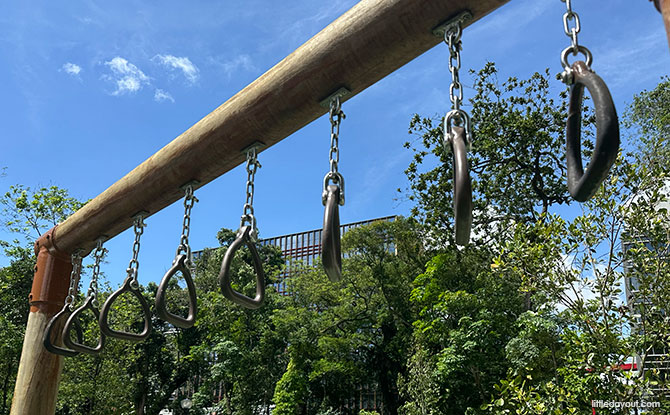
A series of hanging grips provide a challenge for kids, inviting them to swing from one end of the play structure to the other.
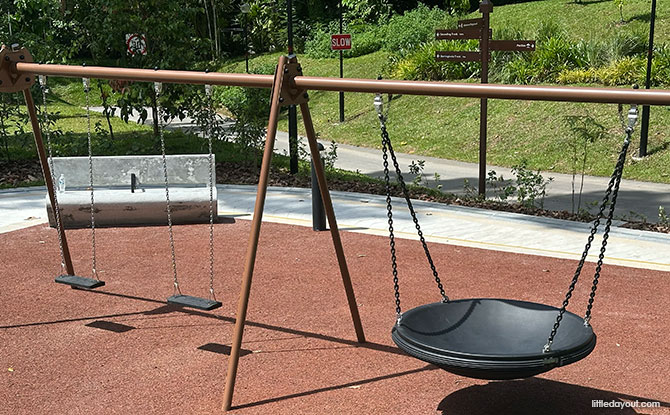
The Punggol Heritage Trail playground also has multiple sets of swings. These range from a circular swing to two pairs of regular swings, one that is set over a sand pit and the other on the padded flooring.
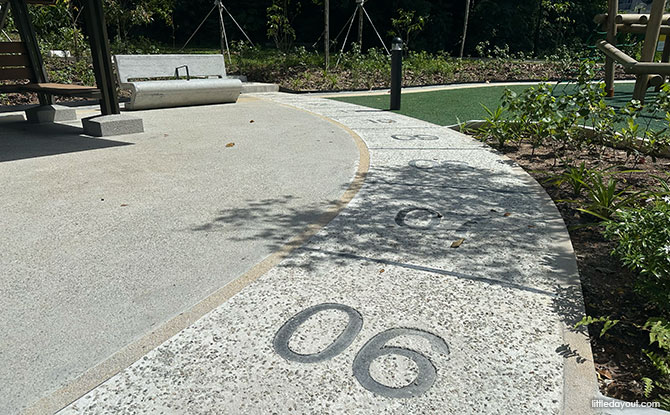
The nod to snakes and ladders comes from a series of numbered squares, just like what you would find on a snakes and ladders board, that run from 1 to 60 up a slope.
Greenery along the Punggol Heritage Trail

Currently, the Punggol Heritage Trail offers trails set amid a lush landscape.
Distinctive features of Old Punggol Road have been retained, such as its original undulating terrain, coastal forest habitat, and existing greenery, inviting visitors to rediscover the area’s rich natural and cultural heritage.
Much of the existing greenery, including trees that have been growing for at least half a century, has been conserved to preserve the area’s unique topography and rustic charm.
The species that can be found along the trail include the Sea Almond (Terminalia catappa) and Common Pulai (Alstonia angustiloba).
Additional native tree species such as the Pianggu (Horsfieldia irya) and Small-leafed Oil-fruit (Elaeocarpus mastersii), known for attracting birds, have been introduced to establish a multi-tiered native forest planting palette.
The trees serve to provide shade for pedestrians and also play a role in strengthening the ecological connectivity in order to support biodiversity in the area.
Features along the Punggol Heritage Trail

One of the most distinctive features along the Punggol Heritage Trails is a former bus stop which once served residents in the area. It has been recreated along the Trail near Campus Boulevard.
The old bus stop features a shelter design that is reminiscent of Singapore’s bus stops in the past.

Along the trail, there are also several interpretive signboards. These recall the past and those who are walking along the trail can stop to learn more about the area’s rich heritage from the interpretive signages, as well as information panels at the bus stop.
Supported by the National Heritage Board, these signage highlight key chapters of the area’s past, including Kampong Punggol, its private zoos, and the pig farming district that once existed in Punggol.
Remaining Section of Trail to be Completed by End 2026

The remaining 900-metre stretch of Punggol Heritage Trail is expected to be completed by end-2026.
Along this stretch of the Punggol Heritage Trail, there will were trees such as the conserved Api Api Ludat (Avicennia officinalis) mangrove trees, once a distinctive feature of the area’s coastal habitat, as well as a new connection to Punggol Jetty.