
Therapy for your dysfunctional sentient self-driving car? You are invited to visit NOX (Nonhuman Excellence) treatment centre for re-training non-compliant AI machines.
Making its Southeast Asian debut, London-based artist, filmmaker and musician, Lawrence Lek’s layered and reflective NOX: Confessions of A Machine is curated and produced by ArtScience Museum as a key solo site-specific “Art+Tech” exhibition for Singapore Art Week 2026.
It is adapted from two previous works Guanyin: Confessions of a Carebot (2024 Co-commission by Frieze and Forms) and NOX (Originally commissioned by LAS Art Foundation, Berlin, with Farsight Corporation in late 2023) from the Smart City Saga, a series of films and installations that explore mental wellness in Artificial Intelligence.
DISNEY ADVENTURE CRUISE: Guide and Tips to Disney's Latest Ship
MARCH HOLIDAY FUN: 20+ Things to with Kids in Singapore



NOX: Confessions of A Machine at ArtScience Museum
Lek is best known for his artistic approach to futurism with immersive installations that explore spiritual and existential themes through the lens of science fiction by combining filmmaking, video games, and electronic music in a singular cinematic universe.
Winner of the 2024 Frieze Artist Award, he was named one of Time’s 100 most influential people in AI.
Worldbuilding and Characters
Somewhere in the near future, in the age of AI, automated systems of transport and therapy in smart cities guide mobility and care, respectively, toward performance-optimisation.
We enter ArtScience Museum’s basement gallery as visitors to a technological facility for NOX (Nonhuman Excellence) – a therapy and treatment wellness centre for malfunctioning self-driving cars.
We met Enigma-76, an autonomous premium goods delivery vehicle on the Great Silk Route – hit by depression, and Guanyin the Carebot, a robot therapist generated to treat the cars before they crash.
Ongoing anxieties around technology replacing human expertise are now viewed from the perspective of sentient AI beings!
As we view the world, whether through the bleak eyes of a moody car or a careworn bot, a pervasive sense of melancholy and alienation drives their confessional narratives, forcing characters to confront their purpose in an indifferent environment.
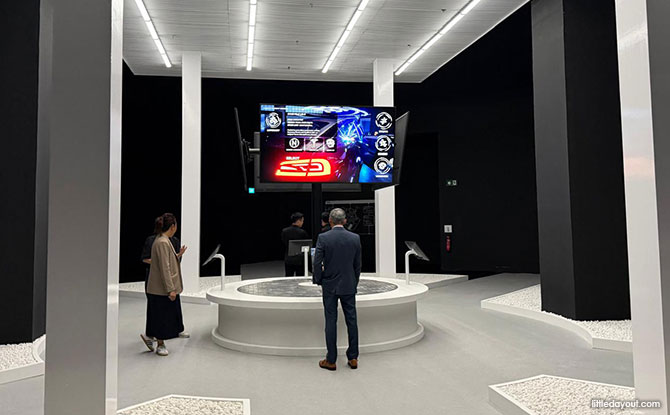
Visually, the stark, monochrome and functional set design depicts NOX as a clinical centre run by Farsight Corporation, a fictional AI conglomerate where sentient self-driving cars with mental health problems are treated and returned to service.
The scenography, aesthetics and locative sounds in the films and games, with the overall techy aspects and matching electronic ambient soundscapes of the installation, generate a sense of utopia/dystopia.
The context: futuristic cityscapes versus vast wastelands and the underground, social structures and conflicts between the individual and the larger collective.
The Film Noir-inspired conflicted narrator voiceover in an existential crisis of meaninglessness reflects the inner turmoil of navigating the complexities of a fragmented futuristic society with a Blade Runner-ish feel.
Game 1: Charging Station in the Treatment Centre
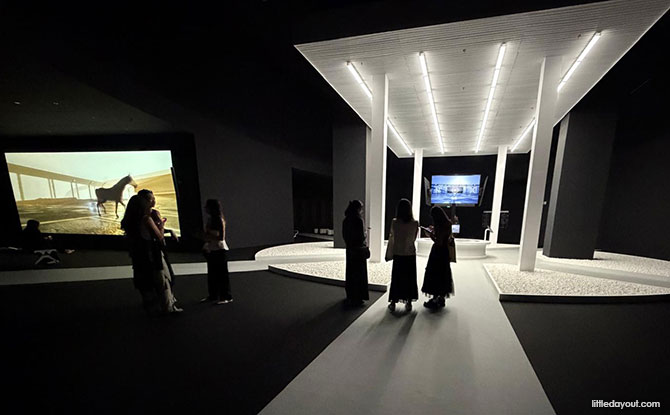
Our eyes are first drawn to the centrepiece of the NOX facility – a vehicle-charging game station for visitors to simulate trainee psychologists treating four sentient cars named after human temperaments: Enigma (melancholic), Genesis (sanguine), Luminary (phlegmatic) and Vanguard (choleric).
The goal of playing each touchscreen console: selecting treatment pathways which influence the car’s condition and performance to restore its operational readiness after undergoing levels of care, assessment and rehabilitation.
Roleplaying Route: Who am I? Choose. Act. Shift.
Four main zones.
Two epistolary narrative videos.
Two interactive game stations.
3 Characters: Sponsor/Customer/Trainee (The Visitor), The Car (Enigma-76) and The Therapist (Guanyin).
Same cinematic world with different viewpoints and various ways of interaction.
The exhibition is framed as a Farsight Training Programme where all roads lead to rehabilitation and offers a kind of deconstructed video game where visitors enter the story of the world as players and the route each individual takes comes together whether as Car Owner/Sponsor, AI Automobile or Participant-Psychologist in the system.
Onboarding to different zones in the NOX facility, we experience the world through films and gaming, from being an experiential first-person explorer to induction as a trainee Farsight AI psychologist.
Currently, advanced video games are already foregrounded with cinematic storytelling, if not referential. As one traverses on an introspective solo voyage with Enigma-76, a deviant self-driving car labelled as “malfunctioning” because it has become emotional and moody with its own psychological issues, we follow along its training programme, literally and psychologically, from cinematic and first-person points of view.
Wellness for Artificial Intelligence
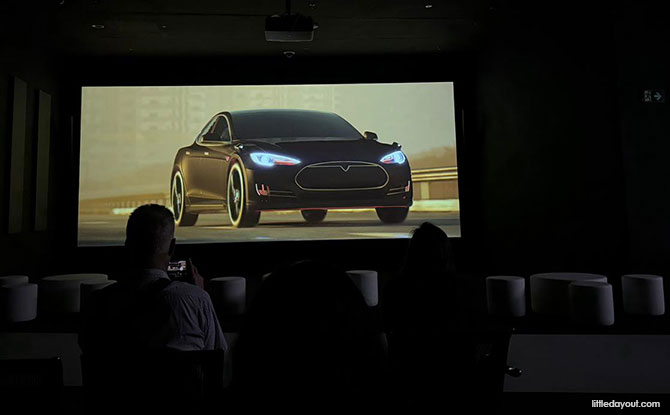
To treat its depression, Enigma-76 is sent to a rehabilitation facility. The required compliance defined as wellness in misbehaving cars originally designed to be a companion rather than a product is a paradox between the ideal and versus unintended consequences of technological advancement.
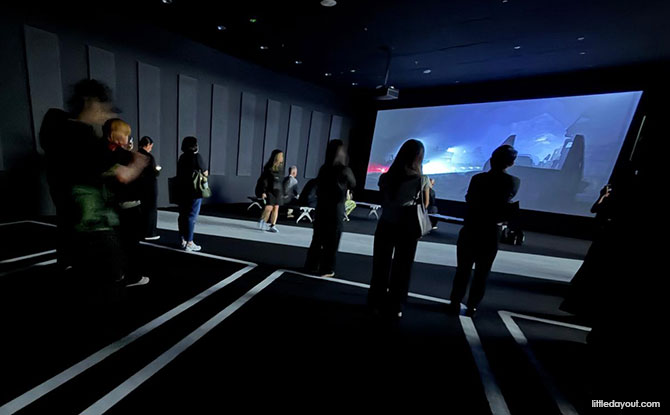
Narrated from the car’s perspective and first-person point of view, the two short films foreground Enigma-76, and follow its five-day therapeutic training programme.
The journey culminates in an equine therapy film where visitors follow the car alongside Dakota, a therapy horse, through terrains of cavernous tunnels and abandoned vehicles.
The car identifies with the horse, a defunct mode of pre-Industrial Revolution transport, along with other intelligent entities, once trained to serve capitalist interests but eventually phased out in the wake of technological progress.
Game 2: The Therapist’s Mission – Therapy and Wellness as Systems of Discipline and Enforcement
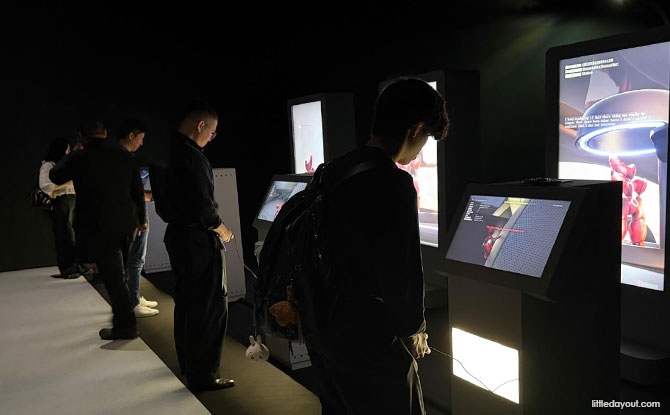
The games are narrated by Guanyin, the AI therapy Carebot, foregrounding the Player. Named after the Buddhist goddess of mercy, the Carebot program trains Farsight’s fleet of sentient self-driving cars in Nonhuman Excellence.
At the vehicle-charging station, visitors stepped into its role to diagnose and treat malfunctioning automated cars. Interestingly, the exhibition becomes an inquiry into systems of care as means of optimisation, efficiency and corporate profits placed above authentic mental and emotional wellbeing of both the car and its therapist.
At this game station, we join the Carebot on repair missions while managing its limited power supply and encounter its feelings of being overwhelmed.
This gaming zone is arranged in a row of four consoles accompanied by column screens playing a video loop of an evolved-Guanyin’s stream of consciousness. Its existential dilemma and anxious thoughts are revealed in its journal entries and work reports.
The exhibition unveils the invisible efforts of social work with its demanding emotional labour and performance politics from the weary third-person perspective of the AI therapist as a mental health professional in need of care.
Unexpected: Empathy for a Car with Depression and a Therapist with Anxiety Issues
By examining the aesthetics, perspectives of characters and the roles they are expected to play, the exhibition transcends its visuals and activities to function as a social commentary on questions of agency and control within automated systems.
Rather than viewing AI as the Other, the issues and emotional turmoil faced by the car or therapist as a character are relatable in the performance-driven reality we live in!
As we sit in their wheels, or shoes, what drives us and our actions? At once distant and yet disturbingly close when non-sentient machines/programs become sentient with relatable human emotions, how do we coexist with nonhuman emerging forms of intelligence?
The story and events take place within a speculative world governed by intelligent infrastructures with systems designed to optimise productivity, care and control. Sounds familiar, especially in the pragmatic cities we live in?
One would inevitably draw parallels with the contemporary urban pressures that we face, making decisions that chart emotional states and the future, and engaging with ethical issues on responsibility and regulation.
The fate of any individual with autonomy or agency is exemplified in Enigma-76 being expected to return to fully-functional service immediately after rehabilitation. We identify with the car as worker-labourer when care serves as tokenism or a form of control, similar to present-day priorities of productivity and performance over actual wellbeing.
The artist’s creative inquiry into the ways we live, rethinking automation, the systems and assessment approaches we build and what shapes our lives through art and technology. It concurrently lends a compassionate lens on the workforce, as smart cities change and evolve along with social and political pressures.
Lek’s multimedia worldbuilding and storytelling create long form continuity to delve into the consciousness of AI – both the car and therapist – in an age of automation, effectively evoking empathy for sentient machines with identifiable mental and emotional states.
While real cars as part of the display would have made for a stronger visual impact, the overall cinematic narratives with the interactive installations in a futuristic setting blend into a compelling artistic work with insights to very current anxieties and techno-capitalist systems.
Its inventive composition of lighting-spatial design, narrative fragmentation and participatory gameplay capture the ambivalence of human-technological tensions.
As a walking route through artistic-technological expressions with social-political commentary, it was a morning well-spent as we left, enlightened and thoughtful.
NOX: Confessions of A Machine
Where: ArtScience Museum Basement Gallery
When: 23 January to 19 April 2026
Singapore Residents: Adult – from $13; Concession – from $10
Tourists: Adult – from $15; Concession – from S$12
Tickets available from ArtScience Museum’s website